

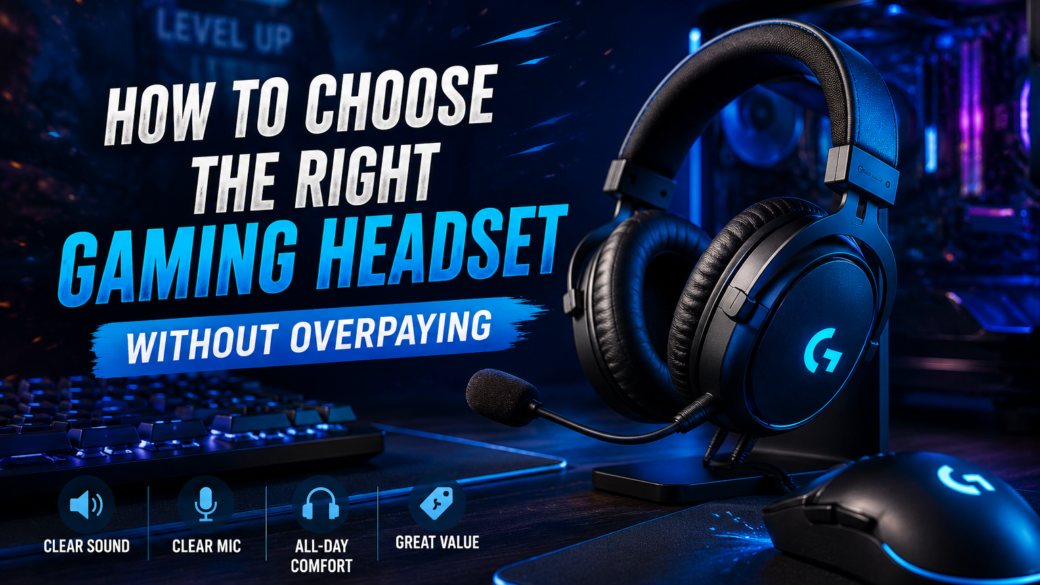
A gaming headset is one of those things that seems easy to buy until you actually start looking.

You open a store, search for gaming headsets, and suddenly you’re staring at dozens of models promising 7.1 surround sound, ultra-low latency, massive drivers, AI microphones, RGB lighting, and enough marketing terms to make your head hurt.
I’ve used cheap headsets, expensive ones, wired ones, wireless ones, and a few that I regretted buying almost immediately.
The biggest lesson I’ve learned is pretty simple: a more expensive headset isn’t automatically a better gaming headset.
Here’s what I actually look at before buying one.
Wired or wireless?
This is usually the first decision.
I used to automatically choose wired because I didn’t want another device that needed charging. And honestly, wired still makes a lot of sense.
You plug it in and it works. No battery to think about, no wireless connection to worry about, and you can usually get better value for your money.
Wireless is much better than it used to be, though.
If you move around a lot, play from a couch, or just hate having a cable rubbing against your desk, the extra freedom is great. Modern 2.4 GHz gaming headsets can also have very low latency, so for most players the delay isn’t something you’ll notice.
Bluetooth is a different story. It’s convenient for phones and everyday use, but I wouldn’t make it my first choice for competitive gaming.
Personally, for a desktop setup I still like wired. For a cleaner setup or console gaming, I’d probably go wireless.
Don’t get distracted by huge numbers
You’ll see headsets advertising 40 mm drivers, 50 mm drivers, 7.1 audio, spatial sound and all kinds of other specifications.
They’re worth knowing about, but don’t buy a headset because one number looks better.
What matters is how the headset is actually tuned.
For gaming, I want to hear small details clearly. Footsteps, reloads, distant shots and the direction they’re coming from matter much more to me than having ridiculous bass.
Too much bass can actually make things worse because explosions and music start covering quieter sounds.
And don’t assume you need virtual 7.1 either.
A good stereo headset can be excellent for gaming, especially when the game itself already has good positional audio.
The microphone matters more than I expected
I ignored microphone quality when I bought some of my first headsets.
Bad idea.
You might not hear your own microphone, but everyone in Discord does.
A decent gaming mic doesn’t need to sound like a studio microphone. Your teammates just need to hear you clearly without also hearing every keyboard press, mouse click and fan in your room.
If possible, listen to an actual microphone test before buying instead of trusting the description on the box.
This is one of those things YouTube reviews are genuinely useful for.
A removable or retractable microphone is also nice if you sometimes use the headset for music or take it outside.
Comfort can ruin an otherwise great headset
This is probably the thing I’d pay the most attention to now.
A headset can sound amazing and still be a terrible purchase if you want to take it off after 40 minutes.
Weight matters.
Clamping force matters.
The ear pads matter.
Even the shape of the ear cups can make a difference.
If you wear glasses, pay extra attention to this because some headsets push the arms of your glasses against your head. It doesn’t feel terrible at first, but after a long gaming session you’ll definitely notice it.
I also prefer ear cups that give my ears a little room instead of pressing directly against them.
It’s difficult to judge comfort from a specification sheet, so this is another area where long-term user reviews are more useful than marketing material.
Check compatibility before buying
This sounds obvious, but it’s surprisingly easy to forget.
PC is usually straightforward, but consoles can be more complicated.
A wireless headset that works perfectly on PC and PlayStation might not support Xbox wirelessly. Some USB features might only work on certain platforms. Software-based EQ or surround sound can also disappear when you switch devices.
So before buying, check exactly how the headset connects to the platform you actually use.
Not just whether the manufacturer puts a PlayStation, Xbox or PC logo somewhere on the page.
Check the connection itself.
USB?
3.5 mm?
Bluetooth?
2.4 GHz dongle?
And if you’re planning to use the same headset with several devices, make sure switching between them isn’t a pain.
Don’t pay extra for features you won’t use
RGB looks cool on a desk.
I get it.
But you can’t see the lights when the headset is on your head.
The same goes for companion apps, multiple sound profiles and dozens of EQ settings. They can be useful, but only if you’re actually going to use them.
I’d rather spend the money on better comfort, build quality, microphone performance or sound.
Before buying, I normally separate features into two groups: things I’ll use every day and things that just look good on the product page.
That makes choosing between two similar headsets much easier.
So how much should you spend?
You don’t need a $300 headset to enjoy games.
There are genuinely good options at reasonable prices, especially if you don’t need wireless.
I’d rather buy a solid mid-range headset with good fundamentals than a more expensive model packed with features I don’t care about.
Start with your budget, then decide what you absolutely need.
For me, that list would be:
- comfortable for long sessions
- clear positional audio
- a microphone that doesn’t annoy my friends
- reliable connection
- decent build quality
Everything after that is a bonus.
One last thing
If you can try a headset before buying it, do it.
Reviews can tell you about sound, microphone quality, battery life and features. They can’t tell you exactly how a headset will feel on your head.
And if you can’t try it, don’t judge it from one review. Check a few opinions, especially from people who’ve actually used it for several months.
The best gaming headset isn’t necessarily the one with the biggest drivers, the most features or the highest price.
It’s the one you can put on, forget about, and keep playing.